
SIM Modem | UE Category
4G 5G Router Category
What is a 4G 5G Modem Router?
4G/5G router uses the embedded cellular modem and a SIM card to connect to the mobile network and deliver internet connectivity. The 4G/5G cellular routers can work widely once there is fair mobile signal coverage. They offer a flexible cellular internet solution for home, office, IoT, and industrial applications. The 4G/5G routers usually support fallback to lower networks. For example, the 4G router supports a 2G 3G connection, and the 5G router supports a 3G and 4G LTE fallback.
What is the 5G LTE Modem UE Category?
Modem UE category refers to user equipment for cellular modem chipsets used in 4G/5G routers. The UE category determines the performance of 4G/5G cellular routers, including download and upload speeds, frequency bandwidth, carrier aggregation, and MIMO technology.
The latest 5G routers support UE categories from Cat 15 to Cat 32, and 4G LTE routers support from Cat 1 to Cat 20. The higher UE category modems provide faster potential speeds and consume more mobile data traffic due to greater bandwidth and advanced cellular capabilities. Choose a higher-grade category modem that future-proofs your router, leading to a better networking experience. However, the actual mobile internet speeds depend on data plan class, cellular carrier network coverage, and mobile signal quality.
OutdoorRouter provides 4G routers in different LTE UE categories of Cat 6, Cat 12, and Cat 16. Each has a diverse speed rate and benefits for various application scenarios. You can choose 4G or 5G UE category modems depending on how fast the speed and throughput are required. The comparison chart below shows their speed rates and specifications.
4G LTE and 5G NR UE Category Comparison Chart
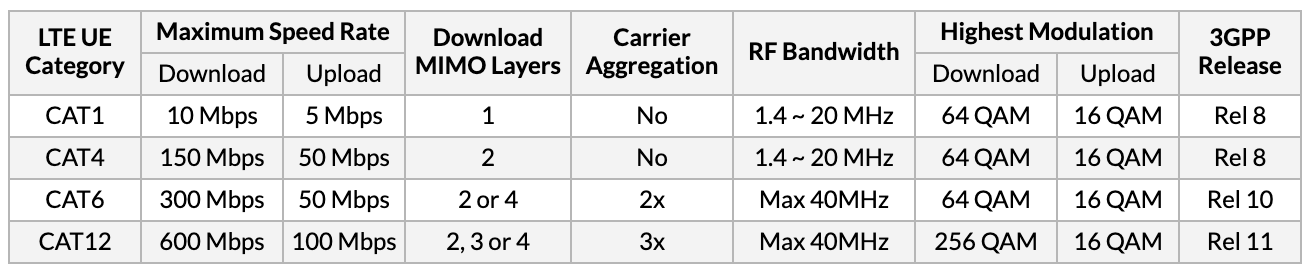
| UE Category | Maximum Speed Rate | Download MIMO Layers |
Carrier Aggregation |
Bandwidth | Highest Modulation | 3GPP Release | ||
| Download | Upload | Download | Upload | |||||
| 5G X62 | 3.4 Gbps | 900 Mbps | 4×4 | 5x | 100 MHz | 256 QAM | 64 QAM | Rel 16 |
| 5G X55 | 2.4 Gbps | 500 Mbps | 4×4 | 5x | 100 MHz | 256 QAM | 64 QAM | Rel 15 |
| CAT 16 | 1Gbps | 150 Mbps | 3×3 | 5x | 100 MHz | 256 QAM | 64 QAM | Rel 14 |
| CAT 12 | 600 Mbps | 150 Mbps | 2×2 | 3x | 40 MHz | 256 QAM | 64 QAM | Rel 11~12 |
| CAT 6 | 300 Mbps | 50 Mbps | 2×2 | 2x | 40 MHz | 64 QAM | 16 QAM | Rel 10~12 |
| CAT 4 | 150 Mbps | 50 Mbps | No | No | 1.4~20 MHz | 64 QAM | 16 QAM | Rel 8 |
| CAT 1 | 10 Mbps | 5 Mbps | No | No | 1.4~20 MHz | 64 QAM | 16 QAM | Rel 8 |
As the 4G and 5G mobile networks are widely deployed worldwide, the cellular data internet becomes sufficient and lowers the price. Without the hassles of setup fees, insert a SIM card into the cellular router, and you can start accessing cutting-edge and fast-speed mobile internet for homes and offices.
Check more technical details about the LTE-Advanced 4G modem routers with the carrier aggregation and MIMO antenna array.
5G-NR Router
Download 3.4Gbps
-
 AUS 5G SIM Card Router X55 Cat 16 Modem
US$398
AUS 5G SIM Card Router X55 Cat 16 Modem
US$398 -
UK 5G LTE Modem Router X55 Cat 16 WiFi 6
US$398
-
SIM Card Router X55 5G Modem LTE Cat 16
US$398
-
Outdoor 5G Router Australia Mobile Modem X55
US$423
-
Outdoor Router UK 5G SIM External X55 Modem
US$423


View all 5G-NR routers
CAT 16 Router
Download 1Gbps
-
Outdoor Router CAT16 Cellular Modem WiFi 6 CPE
US$395
-
Outdoor 4G Router WiFi6 LTE-A Modem CAT16
US$395
-
Outdoor 4G Modem CAT16 LTE Router WiFi6
US$395
-
UK Outdoor 4G WiFi 6 Router CAT16 SIM Modem
Original price was: US$395.US$380Current price is: US$380.
-
EU Outdoor 4G SIM Router WiFi6 LTE Modem
US$395


View all CAT16 routers
CAT 6 Router
Download 300Mbps
-
4G WiFi Outdoor Router SIM Slot External Antenna
US$330
-
Outdoor Router 4G Wi-Fi Modem Exterior Antenna
US$330
-
Outdoor LTE CPE 4G Modem WiFi Two SIM Slots
Price range: US$330 through US$395
-
Outdoor Cellular LTE Router SIM Modem CAT6
US$355

View all CAT6 routers