
Oct
SIM Router Solution, Technical Benefits
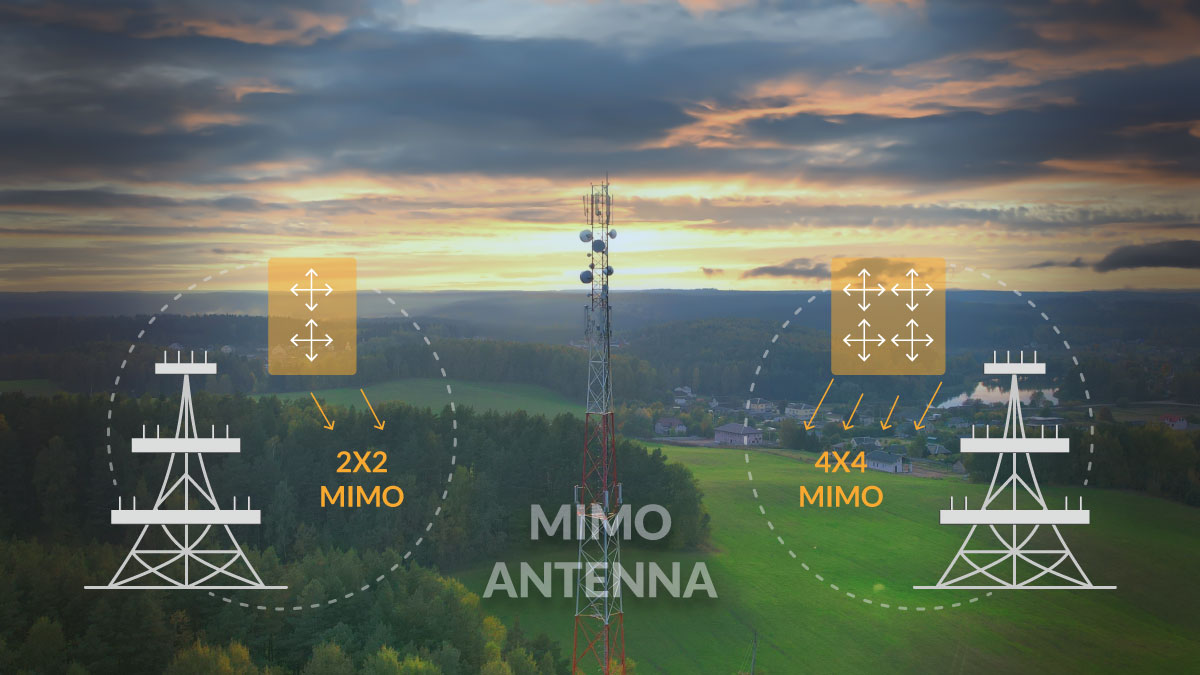
2×2 MIMO vs. 4×4 MIMO Antenna for 4G 5G Modems
What Is a MIMO Antenna?
MIMO, short for Multiple Input Multiple Output, is a wireless communication technology that uses multiple antennas for simultaneous transmission and reception. In mobile modem routers, MIMO antennas improve data throughput, signal stability, and overall link reliability, especially in challenging signal conditions such as outdoor and industrial environments.
2×2 MIMO versus 4×4 MIMO Antenna
MIMO antennas are available in various configurations, including 2×2, 4×4, 8×8, and massive MIMO. The first number refers to the number of transmitters, and the second number refers to the number of receivers in the MIMO system. In mobile router deployments, 2×2 and 4×4 MIMO are the most widely used configurations. The following section focuses on comparing these two MIMO types to highlight their technical differences and practical implications.
2×2 vs. 4×4 MIMO Technical Specifications
| Specification | 2×2 MIMO | 4×4 MIMO |
| Antenna Elements | 2 Tx and 2 Rx | 4 Tx and 4 Rx |
| Signal Path | 2 Streams | 4 Streams |
| Polarization | 1x Vertical & 1x Horizontal | 2x Vertical & 2x Horizontal |
| Power Consumption | Lower | Higher |
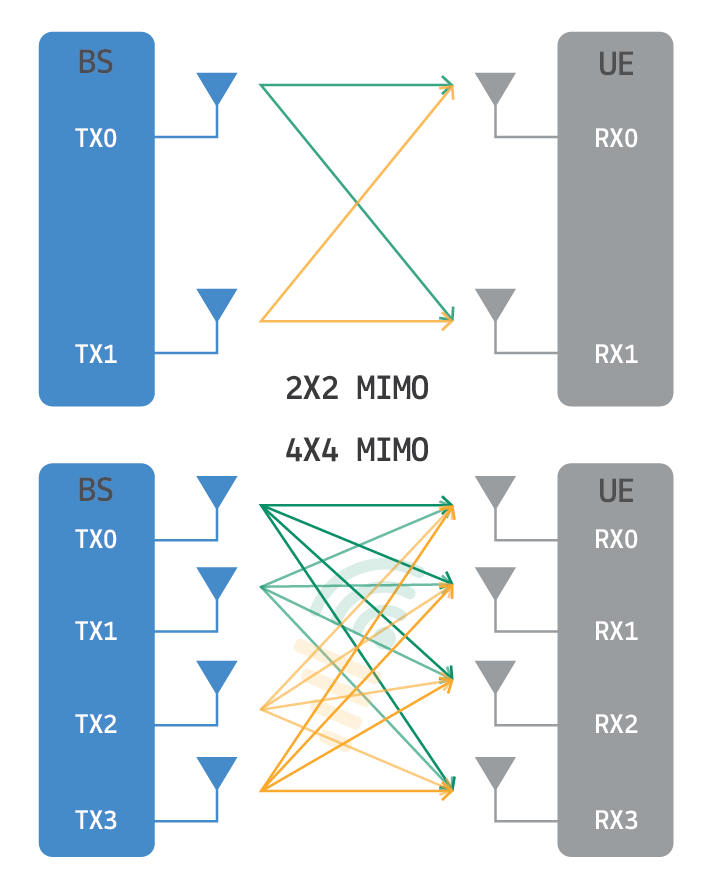
The right-side figure shows the general layout of 2×2 and 4×4 MIMO architecture. It consists of a MIMO-enhanced (BS) base station and (UE) user equipment.
Choose from MIMO Antennas
In general, a 2×2 MIMO antenna is sufficient for most 4G LTE (CAT1/4/6) mobile modems and cost-sensitive deployments, especially in rural or low-load environments.
A 4×4 MIMO antenna is best suited for LTE-Advanced (CAT16 and higher) and 5G-NR mobile modems that actively support higher-order MIMO. In contrast, in poor coverage or low-SINR conditions, antenna gain and installation quality often matter more than the number of MIMO layers.
The table below provides a quick reference for selecting between 2×2 and 4×4 MIMO antennas based on common deployment scenarios and network conditions.
Scenario |
Choose 2×2 MIMO |
Choose 4×4 MIMO |
| 4G CAT1/4/6/12 | Most common choice | Only if the router and network both support 4×4 MIMO |
| 4G CAT16 & 5G | Suitable for moderate throughput needs | Recommended for higher throughput |
| Rural / Low-load Areas | Often sufficient | Gains vary by cell support and site conditions |
| Urban / Congested Networks | May limit peak throughput | More likely to help |
| Poor Coverage / Low SINR | Often more practical | Gains vary by cell support and site conditions |
| Cost-sensitive Projects | Lower total cost | Higher total cost |
MIMO and Carrier Aggregation On Mobile Modem
The advanced 4G-LTE and 5G-NR mobile modems use both MIMO and Carrier Aggregation technologies to enhance cellular signal quality, improve data throughput, and maintain connection stability.
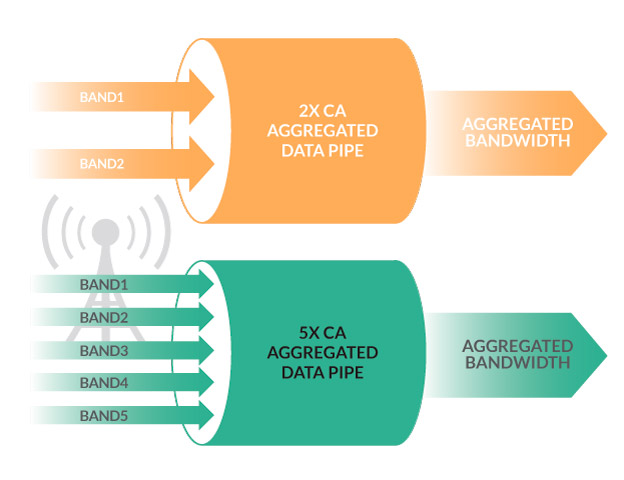
Carrier Aggregation, short of CA, has been introduced since 3GPP release 10 (UE CAT6). It uses multiple frequency channels to increase a single SIM card transmission’s bandwidth and peak speed rate on 4G and 5G data internet connections.
The right-side figure shows the general working principle of 2x and 5x carrier aggregation aggregated data pipes.
Below is a basic introduction to the commonly used mobile modems on our router models. They can natively support MIMO layers and auto-activate carrier aggregation. Their technology grades below might have a deviation value according to different modem versions.
| UE Category | MIMO Download | MIMO Upload | Carrier Aggregation |
| 5G-NR | 4×4 | 2×2 | 5x |
| 4G CAT12 | 4×2 | 2×2 | 3x |
| 4G CAT6 | 4×2 | 2×2 | 2x |
| 4G CAT1–4 | No | No | No |
Remarks:
- MIMO and carrier aggregation are implemented on different carrier frequency bands and do not work peer-to-peer.
- MIMO system is downward compatible. For example, 4×4 MIMO could also support 4×2 and 2×2 MIMO arrangements.
- CAT6/12 modems use nonequivalent 4×2 MIMO layers on download links. 4×2 MIMO refers to 4x transmitters and 2x receivers. CAT1–4 modems use the main and diversity antennas instead of MIMO.
MIMO or CA – Which is Preferred?
The mobile modem prefers carrier aggregation to increase bandwidth and data rates. It also relies on MIMO antennas’ spectral efficiency and spatial separation to improve signal quality and data rates.
MIMO is an antenna technology that utilizes more efficient spatial multiplexing to improve data rates. It uses multiple antennas to transceive parallel data streams. MIMO antennas improve mobile signal quality by minimizing the impact of multipath fading through antenna diversity and benefiting from beamforming to receive a more robust signal.
Carrier aggregation is a mobile modem technology that combines multiple frequency bands from mobile carriers and generates a large aggregated data pipe to improve bandwidth and data throughput.
MIMO Antenna Deployment for Mobile Modems
Let’s get back to the MIMO antenna implementation for mobile modems.
First, we should use the same MIMO layer based on the modem’s capabilities. Then, the same antenna type is preferred to maximize the MIMO antenna’s spectral efficiency. After that, one or more pairs of horizontal and vertical polarized antenna elements are the best option.
2×2 MIMO for CAT6–12 LTE Modem
Support 4×2 download MIMO capability; the CAT6–12 modems have two antenna ports for the 2×2 MIMO antennas.
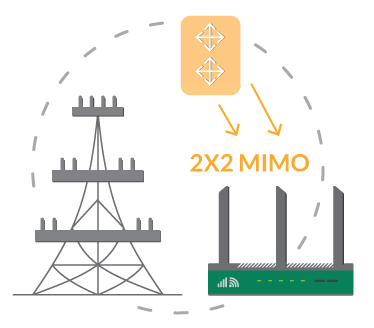
The 2×2 MIMO antenna has two transmitters and receivers, two antenna ports, and a built-in pair of cross-polarized antennas. It supports the full-spectrum 3G and LTE 4G bands, typically 698 to 2700 MHz.
CAT1–4 modem can also use 2×2 MIMO antenna on their main and diverse antenna ports.
4×4 MIMO 5G-NR Modem
The 5G-NR modems used on our 5G routers support 5x carrier aggregation on 4×4 MIMO. The 4×4 MIMO antenna has four cross-polarized antenna elements simultaneously sending and receiving stronger signals. It has four robust antenna ports and covers the 5G cellular frequencies of 698-3800 MHz.
You can also use two 2×2 MIMO antennas on the 5G modem. Please ensure their frequency range covers the 5G cellular frequency spectrum.
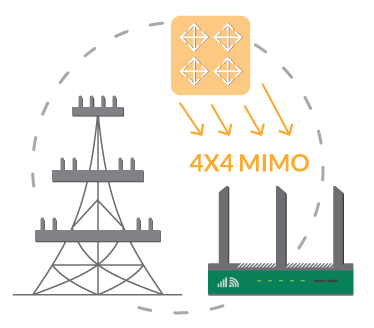
The MIMO antenna offers an excellent solution to improve signal quality and increase data rates for 4G/5G mobile modems. Whether you are in an urban environment with weak signals or in a remote rural area looking for the best Internet experience, the MIMO antenna is your key to unlocking the full potential of your SIM card routers.
The antenna specification and performance are important to the mobile modem. Before deploying the mobile modem, please pay attention to the above-mentioned MIMO layer and frequency range, and also RF efficiency and antenna gain.
Please check the case studies with antenna arrangements. You are welcome to contact us to check the antenna’s suitability and consult a suitable antenna array for various conditions.